Sunday, November 4, 2012

Rhythm Odyssey

iOS | Credits: Lee Lim | Jeremy Kang | Michael Sng | Pradashini Subramaniam |
IGF China 2012 Competition Entry: IGF 2013 Main Competition Entry
Website: http://rhythmodysseygame.blogspot.sg/ 


Synopsis

“Keep to the beat to control Odysseus’ magical Rhythm Boat in a race to escape the wrath of Poseidon in an audio-visual Rhythm-Action experience.”

Rhythm Odyssey is a rhythm-action game in which players tap to the beat of the drums to help the Legendary Odysseus and his Magical Rhythm Boat escape the wrath of Poseidon, Lord of the Seas.
Harness the power of the magical sea creatures while avoiding the deadly wave-attacks of Poseidon – player-actions, power-ups and enemy obstacles in Rhythm Odyssey are designed to build on and enhance the music in each of the game’s levels.

Featuring intuitive touch-based controls and a unique aesthetic style based on Greek pottery, Rhythm Odyssey is designed to be an interactive audio-visual experience that marries audio and gameplay, for the iPad.
The game is slated for a March 2013 release.
 

Videos

Rhythm Odyssey IGF China 2012 Trailer


Screenshots


Wednesday, February 15, 2012

The Grief of Quetzalcoatl

Global Game Jam 2012 :  Unity3D : Browser
Credits: Lee Lim | Jeremy Kang | Magnus Wong Tze Chien | Michael Sng| Shaun Tay | Pradashini Subramaniam |


screenshot


Synopsis

"The ouroboros is a dramatic symbol for the integration and assimilation of the opposite, i.e. of the shadow." - Carl Jung

The Grief of Quetzalcoatl is a metaphorical game where players have to guide the main characters through a series of memories to confront the haunting "Ghosts of the Past".

Players have to Absorb the ghosts to overcome them, however, absorbing Ghosts damages the player but also raises their maximum health in the long run, in reference to the rather ambivalent nature of facing up to one's inner Ghosts.

Coupled with a reinterpretation of the Quetzalcoatl legend, the game spurs players to ponder deeper about the game's metaphorical meaning through its mechanics and its meaning.


Websites
Global Game Jam 2012 Games - The Grief of Quetzaltcoatl
Global Game Jam Website

Thursday, September 29, 2011

Memoirs

Experimental Gameplay Project September 2011 : Indie / Game Maker : PC
Credits: Jeremy Kang


Synopsis

"History is Written by the Victors" - Winston Churchill

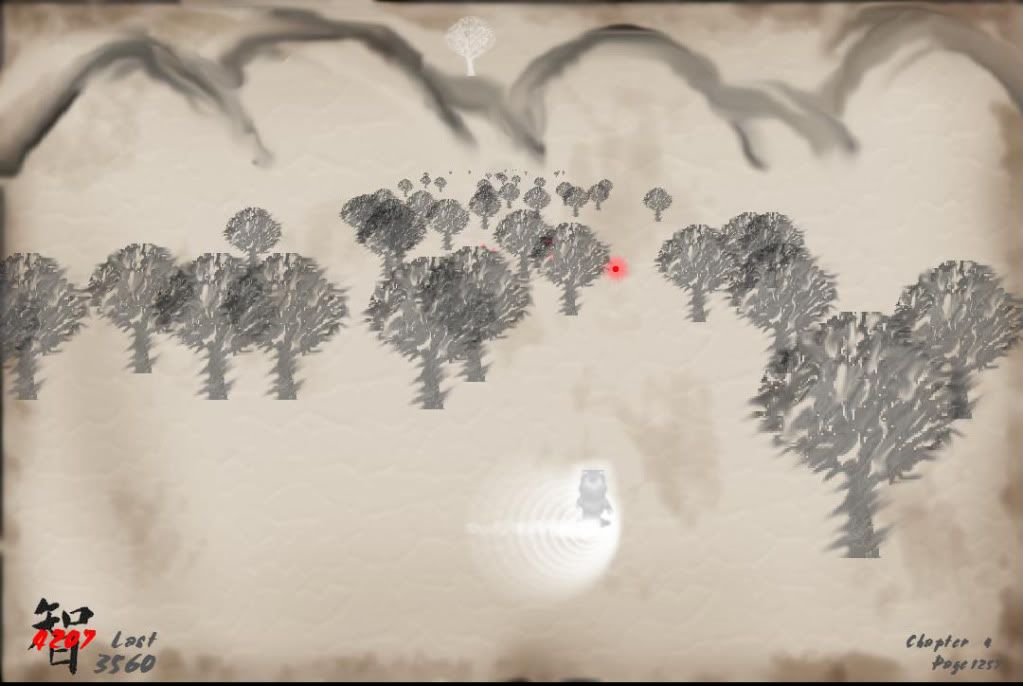
Memoirs is a top-down shooter featuring a gritty story about War, presented in the style of a History Book - the story unfolds and History is literarily written on one page as the Player combats enemy troops on the opposing page.

Designed for the Experimental Gameplay Project September 2011 theme of "Story Game", the original story was conceptualised, written and integrated with the gameplay in 7-days.

In Memoirs, Accuracy and Evasion are valued over an Eager Trigger-Finger, as through reducing the number of Civilians casualties in the story,  Players will gain an entirely different perspective of the events that transpire - hinting at a more sombre underlying message on the story's themes.


Screenshots


Websites

Wednesday, February 2, 2011

Memento Mori

Global Game Jam 2011 : Indie / Game Maker : PC
Credits: Jeremy Kang | Magnus Wong Tze Chien | Kiew Sen Lieh | Pradashini Subramaniam | Shaun Tay | Derrick Ong


Synopsis

"Memento Mori - Remember Your Mortality"

From concept to completion in 48-hours at the Global Game Jam 2011 (Singapore), Memento Mori is a  game based on the famous Latin poem of the same name, based on the jam's theme of "Extinction".
  
Featuring double metaphors related to the theme of "Extinction", players guide a Roman Poet through a series of platforms made from the famous poem, as the words crumble behind him, while he runs towards salvation. Realised through the gameplay and presentation of the game, players are left to ponder on the metaphorical overtones and how the theme of "Extinction" is realised.

Memento Mori also features 2 of the GGJ2011 achievements: "Game for a Cause" and "Mandelbrot".

GGJ-2011 Achievements:
Game for a Cause: The game is about a social or political issue that can be solved solely through increased awareness.
Mandelbrot: The game features some pattern or aspect that fractally repeats itself at different scales.


Screenshots


Websites

Global Game Jam 2011 Games - Memento Mori
Global Game Jam Website

Friday, December 31, 2010

Shibuya Connection

Experimental Gameplay Project December 2010 : Indie / Game Maker : PC
Credits: Jeremy Kang  | Character Artwork: Shaun Tay


Synopsis

"The Shibuya Scramble Crossing is the busiest pedestrian crossing in the world that sees over 1 million people every day. However, all that really matters is finding the one in a
million..."

Designed for the Experimental Gameplay Project (December 2010) theme of "Drawing", Shibuya Connection features a drawing mechanic and is based on the concept of the East-Asian myth of the Red String of Fate.

In Shibuya Connection, players have to draw lines to connect male and female pedestrians on the Shibuya Scramble Crossing with the Red String of Fate to gain points - matching charming characters based on a light-hearted representation of Japanese archetypes; while avoiding deadly Ninjas - all in the span of a frantic 2-minute scramble for the highest points possible.


Screenshots


Websites


Thursday, September 30, 2010

A Firefly Story

Experimental Gameplay Project September 2010 : Indie / Game Maker : PC
Credits: Jeremy Kang | Artwork: Shaun Tay


Synopsis

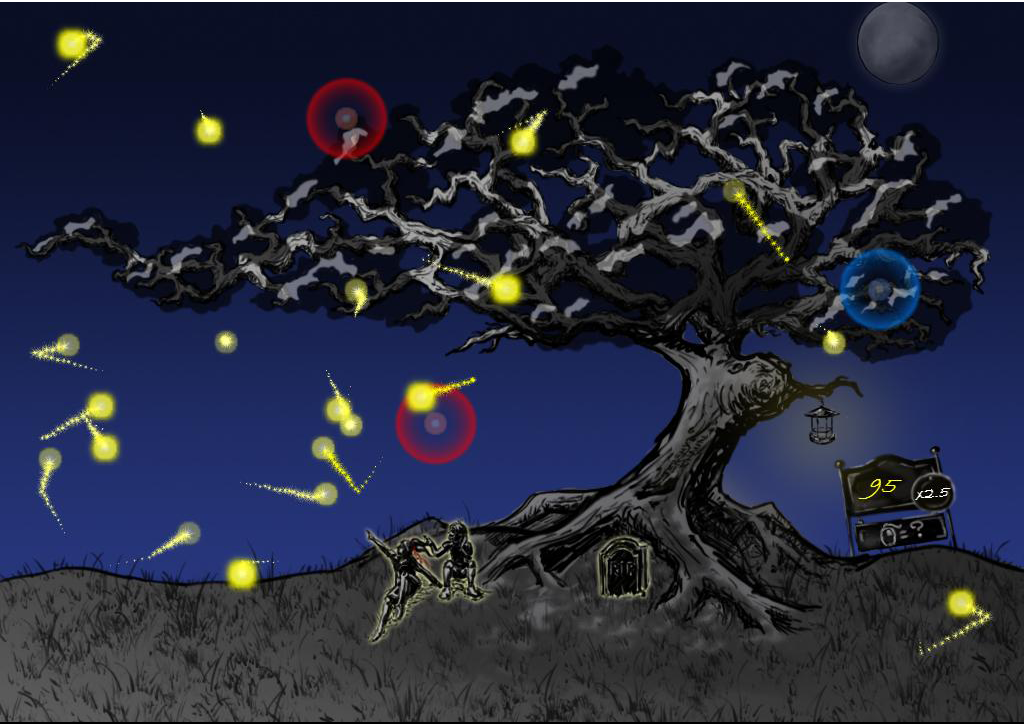
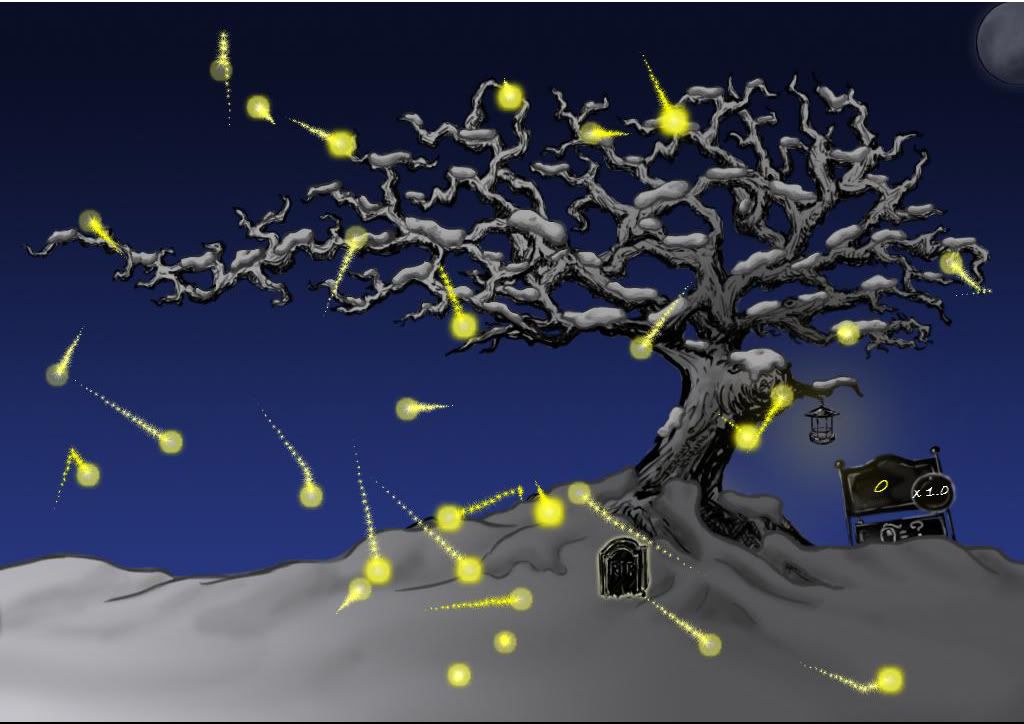
Designed for the Experimental Gameplay Project (September 2010) theme of a "Neverending Game", A Firefly Story is an infinite game  that tells an Interactive Story of Life and Love.

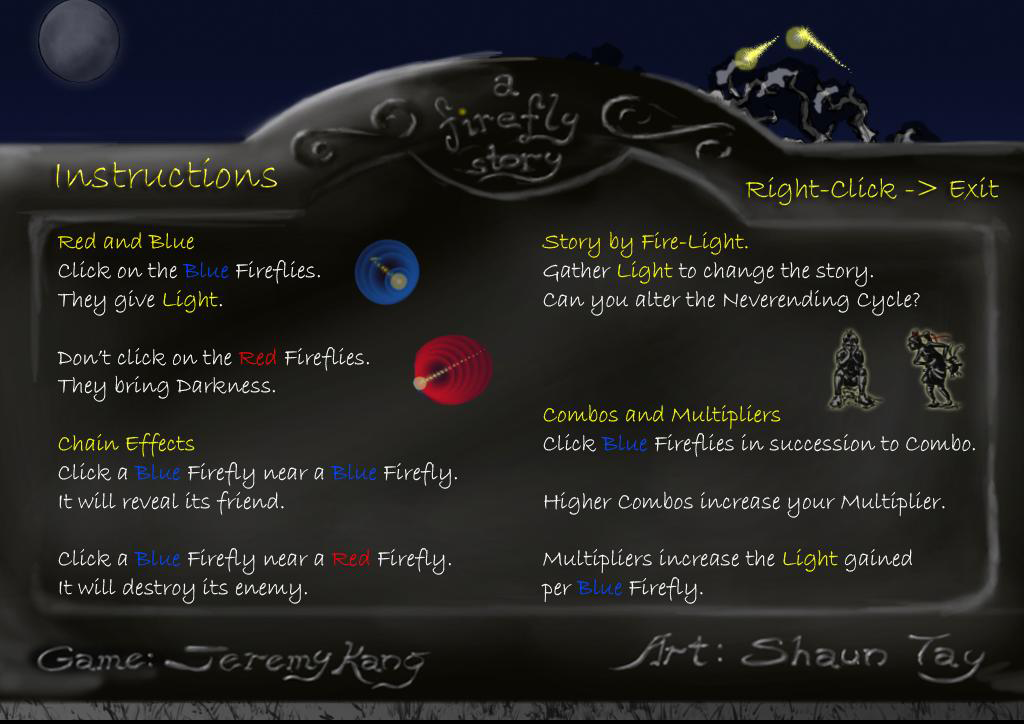
In A Firefly Story, players have to click on the Blue Fireflies to gather light while avoiding the Red Fireflies.

The amount of light gathered changes the way the Interactive Story plays out through the seasons - where each story scene has been carefully crafted to allow for multiple permutations and interpretations based on the player's performance.

- Can you alter the Neverending cycle? -


Screenshots


Post Mortem: A Firefly Story


September's Experimental Gameplay Project was a tricky one, since there was an additional prize for it to be displayed at the Babycastles Indie Game Arcade in Times Square NYC, leading to some additional requirements / tips, which I set as additional design challenges for the game:-

1. Look interesting even when not being played. Attract players!

2. Be instantly playable, understandable, intuitive. Assume your game will be left in any possible state, and must always be ready for one player to leave, and another player to pick up some time later.

3. Avoid a title screen, or any menu system at all. (Like Flow.)

4. Use sound, but don’t rely on it for gameplay.


I thought long and hard about a game idea that could fulfill all the above criteria, based around an infinite game concept to suit the theme of "Neverending", and came up with a couple of quick ideas - but nothing solid really surfaced, as I couldn't put all the pieces together.

Finally, I arrived at the decision to revisit Fire(f)Lies, a game prototype I developed in January over the 48 hours that was Global Game Jam, and decided to expand on that, simply due to the fact that it fulfilled  Design Goal #1: To look interesting when not being played.

The part about making it a Neverending infinite game wasn't too difficult, as it probably meant taking away lives and playing for a high score, or combo count kind of thing, which would well suit the arcade experience - and a lot of games this month chose to interpret it that way, and so did I initially.

A tough decision that I had to make about this concept mid-way was whether to pursue something a bit more arcade-y, and probably more suited to the theme (and in the process improve the chances of getting selected)? Or try to go for something a bit more artsy, which I am more inclined towards, but being slightly less suitable for the theme based on conventional intepretations of an "arcade experience"?

In the end, I chose to go for something a bit more artsy, and more in-line with my design style. 

I tried to ponder a bit deeper into the concept of "Neverending", and I asked myself: " What is infinite or Neverending in this world or life?" Almost naturally, my mind drifted towards the concepts of cycles to be Neverending, and went on to list down some meaningful Neverending cycles.

And my mind started to shortlist cycles, like Seasons, Life and Love, and roots of a multiple narratives started to form, as I realised that these could be used to tell and Interactive Story, in which the player's performance in the game would affect the way the story turns out.


!Spolier Ahead!
(If you haven't played A Firefly Story, you might want to skip this section and come back to it after playing the game.)

It came down to 4 different stories running in parallel, The Story of Seasons (which occurs naturally regardless of the player), to signify the passing of the time, a Story of Life, a Story of Fate (a lovers' tragedy) and a Story of Love (see if you can figure out how these stories are represented through the game); and the player would switch between story "branches" based on his / her "score".

The trickiest part of this entire process however, was for the story to make sense, no matter what the potential branches were, and this came down to a matter of the meaning and interpretation of the individual scenes, through the composition of the visual scenes.

!End Spolier!

Fortunately, my colleague and friend, Shaun Tay - an artist by training, saved my life by offering to help with the story artwork after hearing the concept, allowing the vision to be realised. So thank you Shaun, you were a life-saver this time.

In retrospect, I think that I managed to fulfill most of the design goals set this month, but the last one, about using sound but not relying on it was something that I didn't manage to fully work around, as A Firefly Story is quite reliant on the sound effects to bring out the ambience, and it helps in gameplay that little bit.... ok, maybe quite a bit that actually amounts for something.

But oh well, there's always next month....


Monday, August 30, 2010

Legacy of Wisdom

Experimental Gameplay Project August 2010 : Indie / Game Maker : PC


Synopsis

“I do not think much of a man who is not wiser today than he was yesterday.”  - Abraham Lincoln -

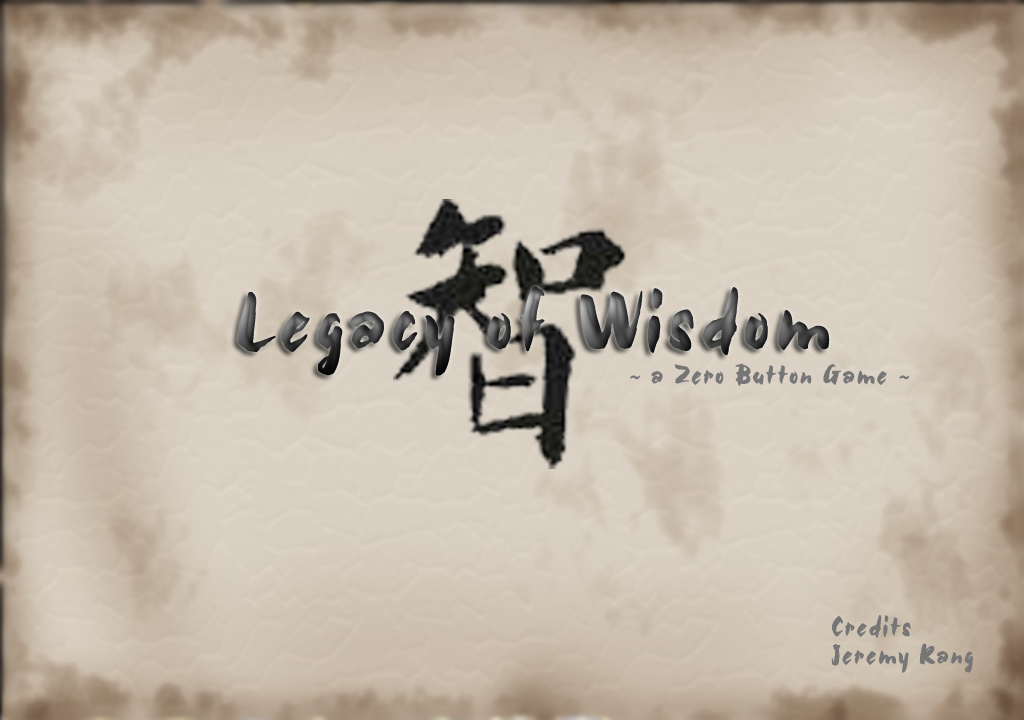
Designed based on the Experimental Gameplay Project theme of a "Zero Button Game" (August 2010) , Legacy of Wisdom's main gameplay uses nothing but mouse movement.

Centering around the metaphorical themes of "Legacy" and "Man's journey in attaining Wisdom", Legacy of Wisdom adopts an oriental aesthetic style based on Oriental Calligraphy / Paintings to help create a "Zen" aesthetic to complement the game's metaphorical themes.

Legacy of Wisdom also features an additional gameplay twist - an experimental take on the concept of "Player Death" in games, toying with the idea that death in games can be a reward as much as a penalty; where each time a player dies, the player is given a reward for his / her next playthrough. 


Screenshots


Websites

Experimental Gameplay Project - August 2010
Experimental Gameplay Project - 0 Button Game Roundup
Accessible GameBase - Legacy of Wisdom
Legacy of Wisdom Post Mortem


Post Mortem: Legacy of Wisdom


! Spoiler Alert !
(If you haven't played Legacy of Wisdom, the following article might potentially give away some aspects of the metaphors involved in the game. Please use the link above to go to the Legacy of Wisdom main page.)

Legacy of Wisdom was designed with 3 Design Goals:-
  • a Zero Button Game
  • a Metaphorical Game
  • experimenting with the concept of "Player Death" in games.

For the latter 2 goals, ideas in which these goals could be expressed and achieved were being nursed in my head a few months before the announcement of the Experimental Gameplay Project's August "Zero-Button" theme.

Once I got wind of the "Zero-Button" theme, it didn't take too long for me to realise that the theme was a good fit for me to create a game that would explore all 3 ideas. In fact, in hindsight, I would say that due to the nature of the theme, it immediately stripped away all other forms of interaction aside from Mouse Movement (for my game), and allowed me to focus on realising the other 2 concepts.

For the Metaphorical Game Design Goal, it is something that I have been very interested in for quite a while now, if my previous work, Avalon Legend is any indication. Initially piqued by Singapore-MIT Gambit Game Lab's Akrasia (in which the team was developing the game in the room behind my team's, back in the summer of 2008), and seeing the powerful execution of metaphor in games like Jonathan Blow's Braid, and thatgamecompany's Flower; I think that there is still alot of room for exploration on the use and portrayal of Metaphors in games, or Metaphorical Games in general.

Thus, picking up the reins of where I left off in Avalon Legend, I decided to take another stab at infusing Metaphors into Legacy of Wisdom, this time dealing with the themes of "Leaving a Legacy" and "Attaining Wisdom". But this time around, I was careful to avoid the mistakes I made in Avalon Legend, particularly on the transparency of the metaphor.

The primary complaint about Avalon Legend's metaphor was that it was a bit too obtuse, and most people didn't get it, even though there was a multi-layered metaphor about "Loneliness" there, crossed with references from Arthurian legend, that I had very complexly put together in the deeper recesses of my creative mind, but a lot of this went by the players totally unnoticed.

Thus, this time around, I was very aware of at least letting the metaphors rear their heads, and leave the players to figure the rest of it for themselves, and how it is reflected in gameplay. Based on initial playtest results, I think most of the testers have gotten it so far, albeit some with a bit of explanation.

Finally, for the concept of "Player Death", I wanted to experiment with the concept in which the death is not necessarily the end in a video game, or an absolute penalty for that matter. Perhaps a little inspired from the Rogue-like genre and more recently, Demon's Souls; I decided to experiment with taking "Player Death" the opposite direction, to some extent making death a stepping stone, power-up or even a reward to some extent, that would benefit a player on his / her next playthrough.

Quite interestingly, the metaphorical theme was able to complement this concept quite well, when it came to the theme of "Legacy", and with enough famous quotes about Knowledge, Wisdom, Legacy and Future generations to justify this.

Initial playtests have shown that players were able to figure using "death" as a potential "mechanic", and have definitely shown some interesting player strategies revolving around "Player Death". The bigger question behind it all now lies very much in whether the balance can be sustained over prolonged play, and whether there is a be-all-end-all strategy to get the high scores.


Wednesday, May 26, 2010

Avalon Legend Official Website

In hope of promoting the game further, I just finished up an official website for Avalon Legend with a clearly emphasis on the game and greater explanation of the metaphorical meaning.

Feel free to take a look at it.

http://avalonlegend.blogspot.com/

Monday, April 5, 2010

Avalon Legend

MDA-Microsoft XNA Initiative: Team EXYLE : Shooter : Xbox Live Indie Games
12th Annual Independent Games Festival Main Competition Entry: Dream.Build.Play.2009 Entry
Website: http://avalonlegend.blogspot.com/


Reviews

"The trial version of the game is well worth playing, if you like the trial you will definitely enjoy the full game."

"The game is presented well, the tutorials are very helpful and a journal and gallery is included which is unlocked via an award type system such as defeating a number of enemies, gaining scores and using knights."

"Graphically the game is good, the sprites are drawn well and the game copes with a large number of enemies on screen."

- www.gammergeddon.com 
(Read the full Avalon Legend review from Gammergeddon.com here.)


"I thought the graphics were simple but effective, and the overall gameplay was fun - I do think the topdown perspective is a good one that more people should use for games. At its heart it's a frantic Geom Wars-style shooter..." - IGF 2010 Judge

"... I did appreciate the frantic pace of the play, and attempts at variation through the different systems..." - IGF 2010 Judge


Synopsis

“Combine and Control two characters simultaneously in a post-apocalyptic abstraction of the King Arthur Legend with a haunting metaphorical overtone.”

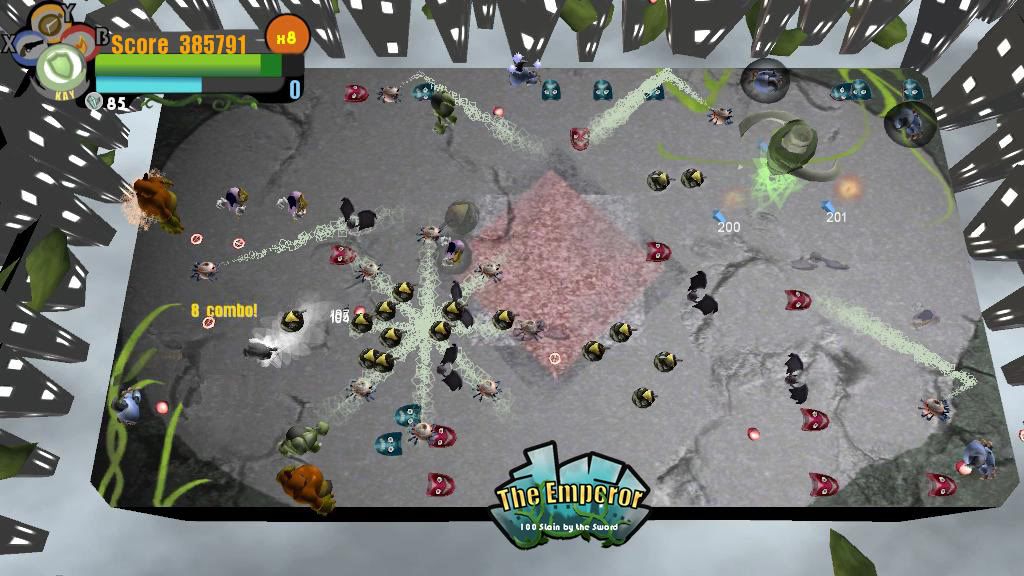
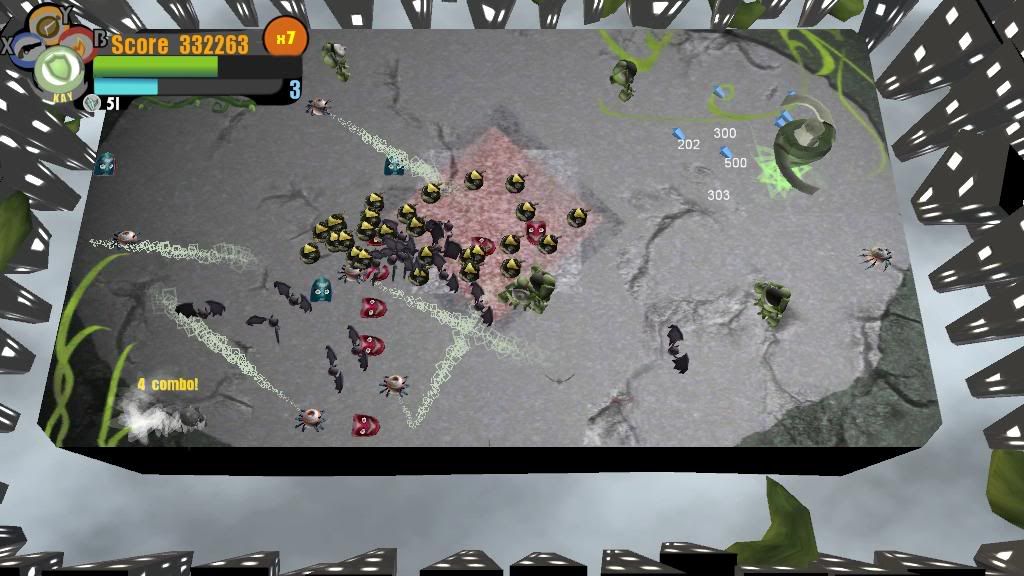
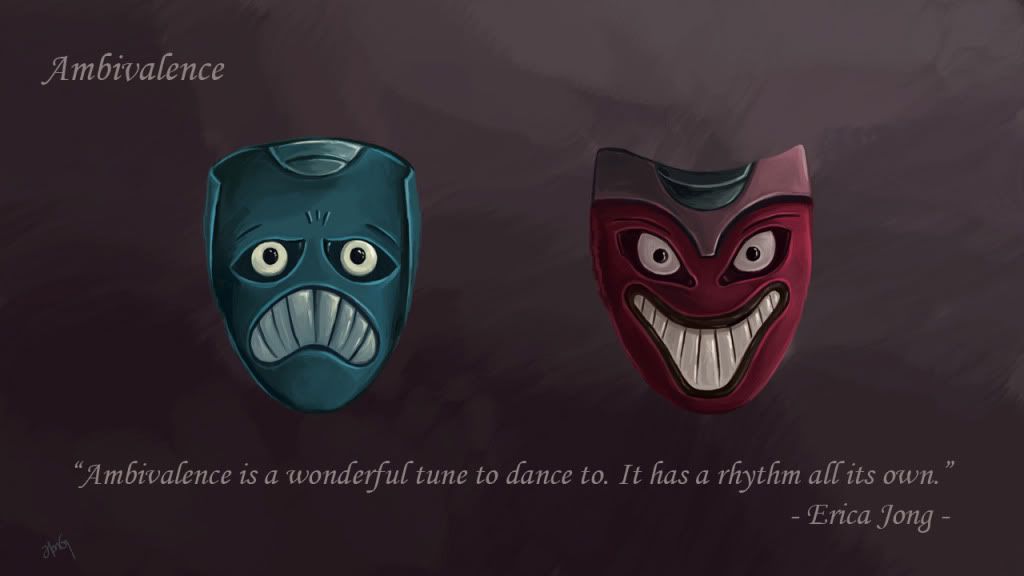
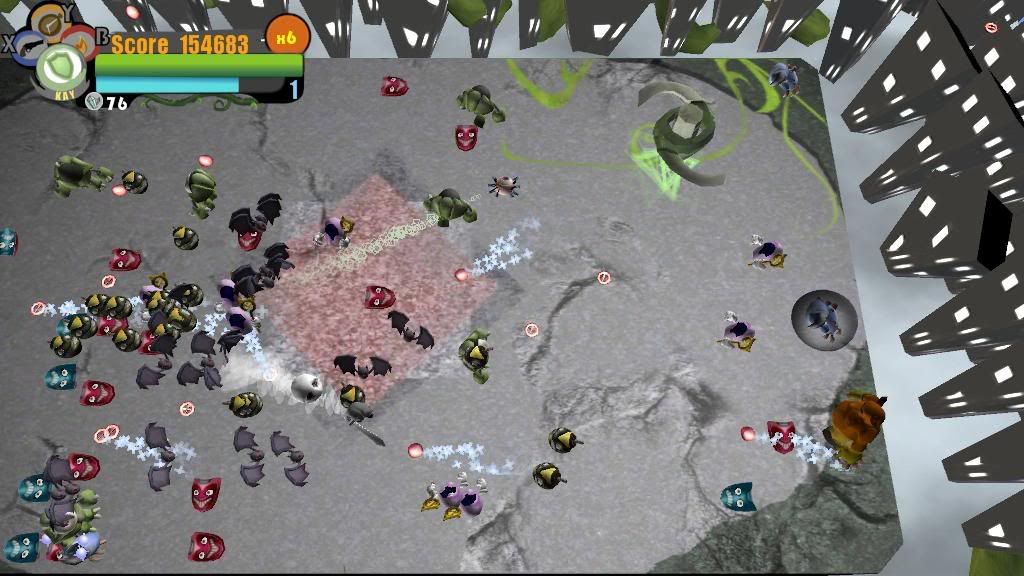
Avalon Legend is a metaphorical game that explores the theme of "Loneliness" through the gameplay mechanics, aesthetics, and narrative of the game.

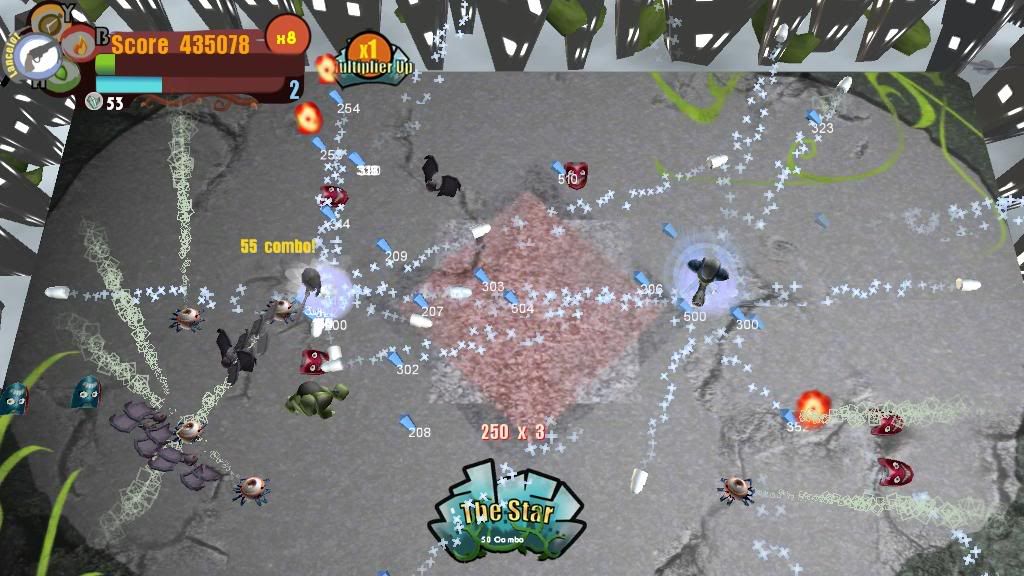
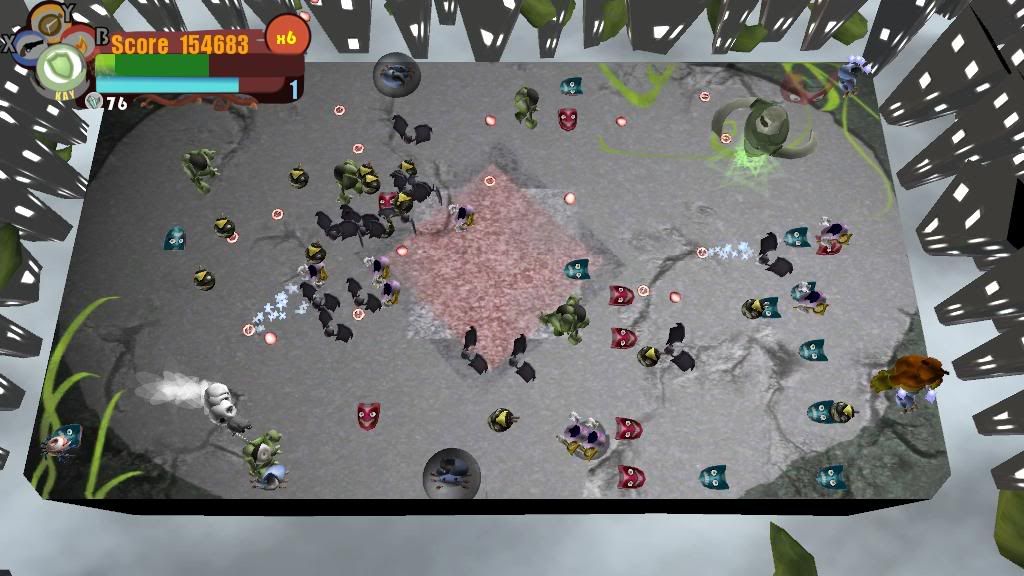
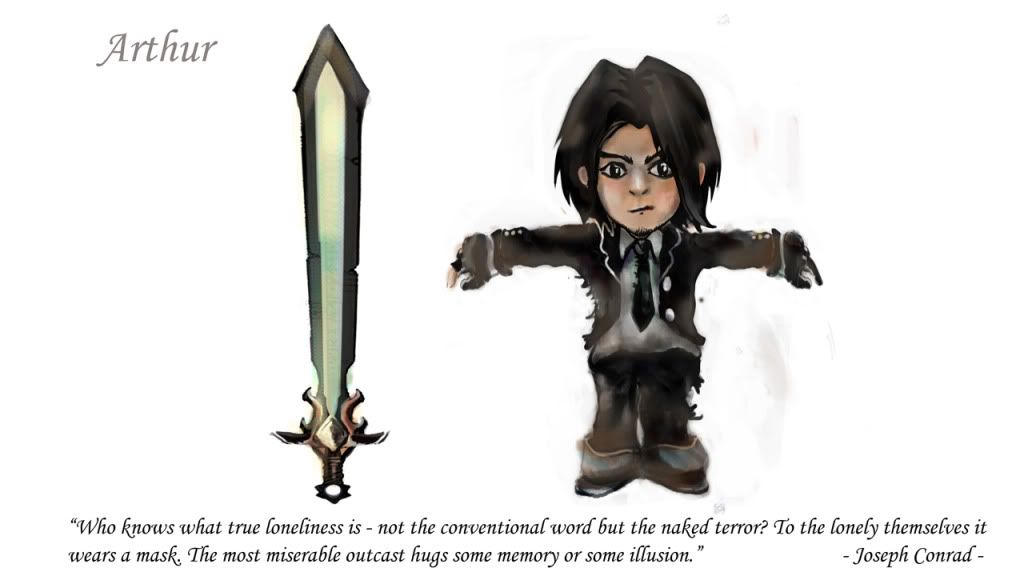
Players take control of Arthur the Exiled in a unique "Single-Player Co-op Experience" where players control 2 characters simultaneously in a fast-paced, top-down "shooter", battle 9 different demons, and unlock secrets to discover the meaning behind Avalon Legend.

Players will be probed to ponder upon the deeper meaning behind the elements in the game and its representations, as every game element is carefully crafted with reference to the central metaphorical overtone.

Aimed to marry white-knuckled, fast-paced gameplay, with a deeper artistic, metaphorical meaning, Avalon Legend aims to appeal to players both viscerally and intellectually.


Key Features

Innovative Control Scheme:
Avalon Legend is built upon a refreshing and unique control scheme that allows players to control up to 2 characters simultaneously, each one assigned to “one-half” of the controller in a “single-player co-op game.”

Unique Game Mechanics:
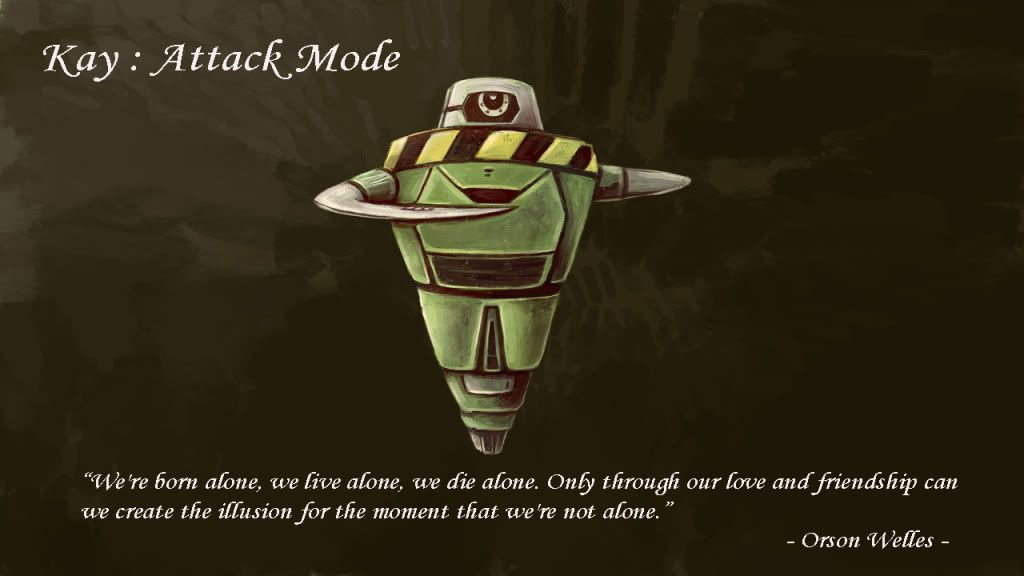
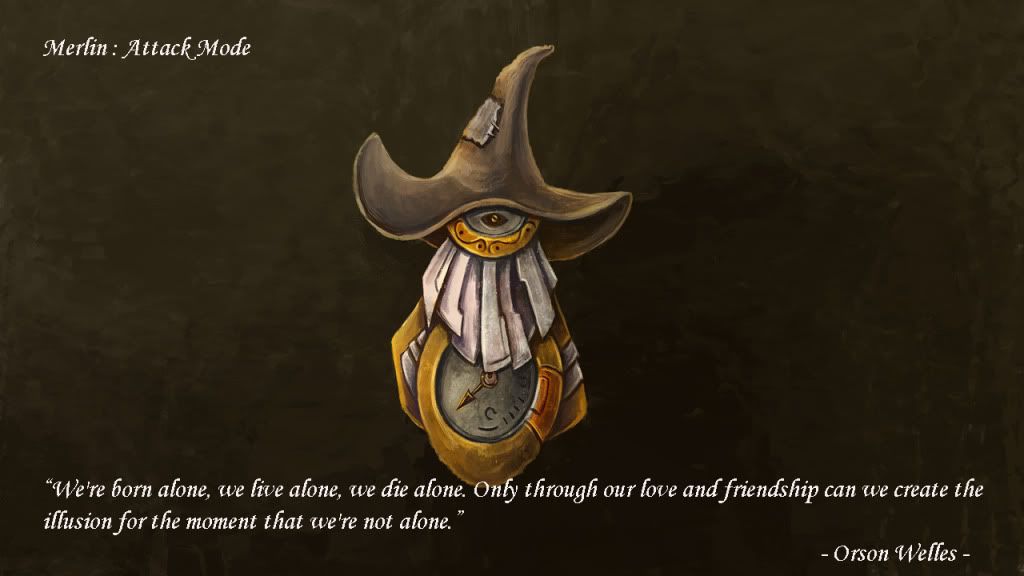
Learn to take control of 2 characters simultaneously over two different modes - Attack Mode and Defence Mode – to cooperatively vanquish enemies in action-packed combat.

5 Playable Characters:
As Arthur the Exiled in a post-apocalyptic world, harness the powers of 4 different robotic companions, across 2 different modes for a combination of 8 different play-styles towards striving for the highest score.

• 9 Different Enemies:
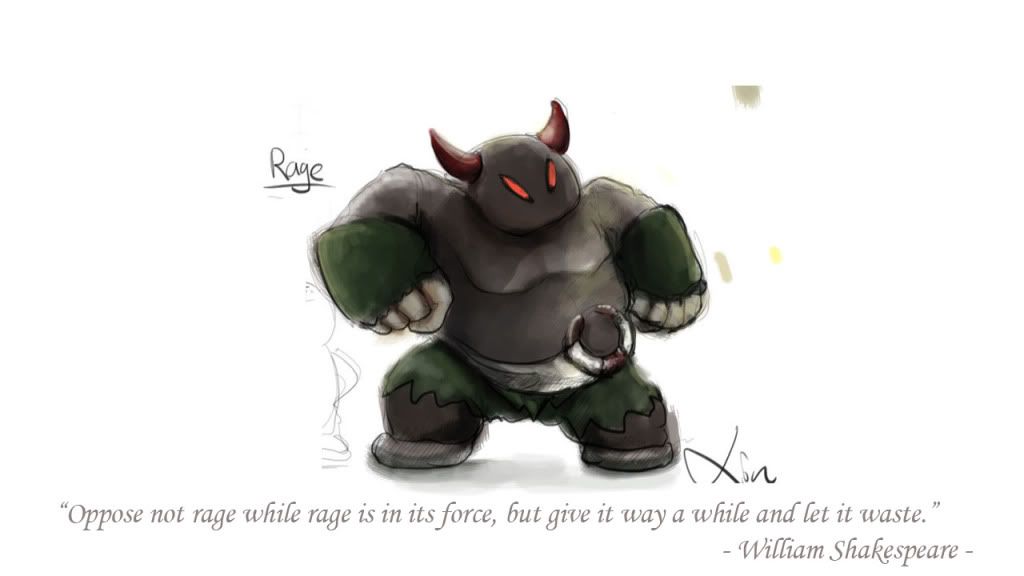
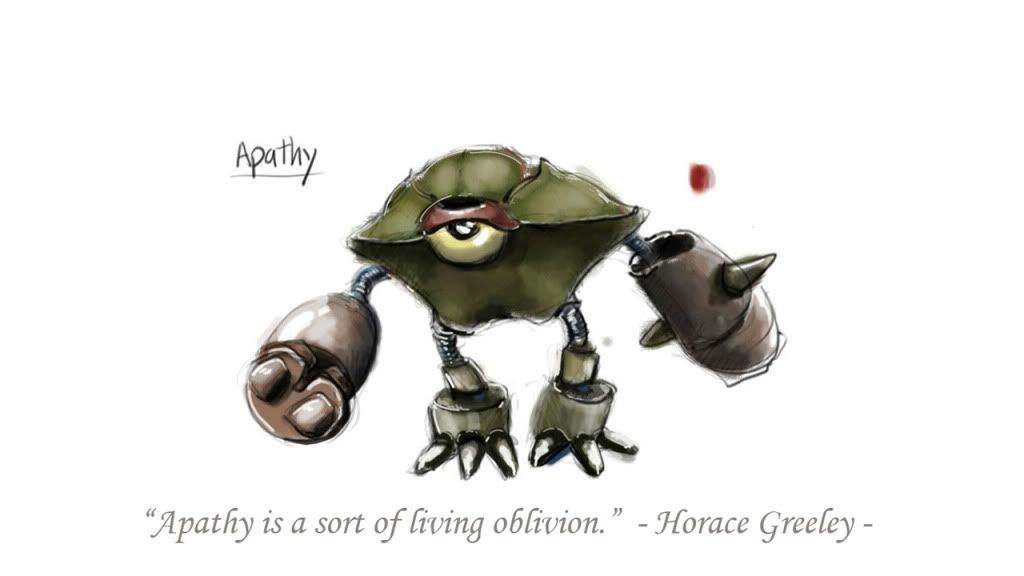
Go up against 9 different types of deadly enemies, each with unique behaviour and weaknesses, based upon their metaphorical representations.

• Deep Metaphorical Overtone:
Set with a metaphorical overtone, players will be probed to ponder upon the deeper meaning behind the elements in the game, as both the main character and the player alike embark on their journey toward discovering the meaning of “Avalon”.

• 2 Different Game Modes:
Avalon Legend boasts 2 different Game Modes, in addition to an in-game tutorial, that allow players of different skill levels to pick-up-and-play Avalon Legend, and make it accessible to hardcore and mainstream gamers alike.

• Replayability and Depth:
Strive for the highest score and learn to master the 8 different play-styles as well as utilizing the special abilities of each knight to fully take advantage of the deeper mechanics in the game, such as the “Enemy Weakness System” or the “Health Restoration System.”

• Enchanting Artwork:
Be enthralled by the Stylized 3D Characters locked into an overhead 2D perspective with snazzy effects for that additional dazzle, giving life to the haunting and vacant landscape of post-apocalyptic Camelot.

• Rewards System:
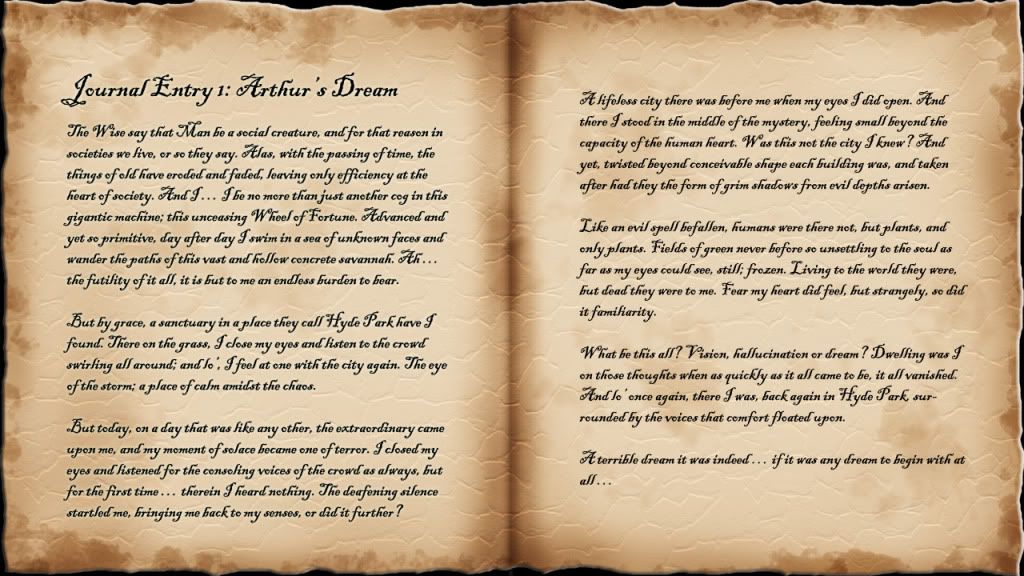
Featuring over 40 rewards unlocked by fulfilling special gameplay conditions. Discover the secret behind the meaning of Avalon Legend through the “Journals” or take the time to view and enjoy the conceptualizations of the different elements in Avalon Legend and find clues towards their metaphorical meanings in the “Gallery”.


Videos


Avalon Legend Official Trailer


Avalon Legend DreamBuildPlay 2009 Trailer


Screenshots


Concept Art


3D Art Assets


3D-Models Preview


Game Story


Websites

Avalon Legend Official Website
Avalon Legend - Xbox Live Marketplace
Avalon Legend Review - Gamergeddon.com
Avalon Legend Review - XBLIGR
Avalon Legend Review - XBLA and XBLIG Ratings